No. Peptides are not steroids. They're built from different molecules, work through entirely different mechanisms, and sit in different legal categories. If you've heard them lumped together, that's gym-culture shorthand, not science.
What steroids are and how they work
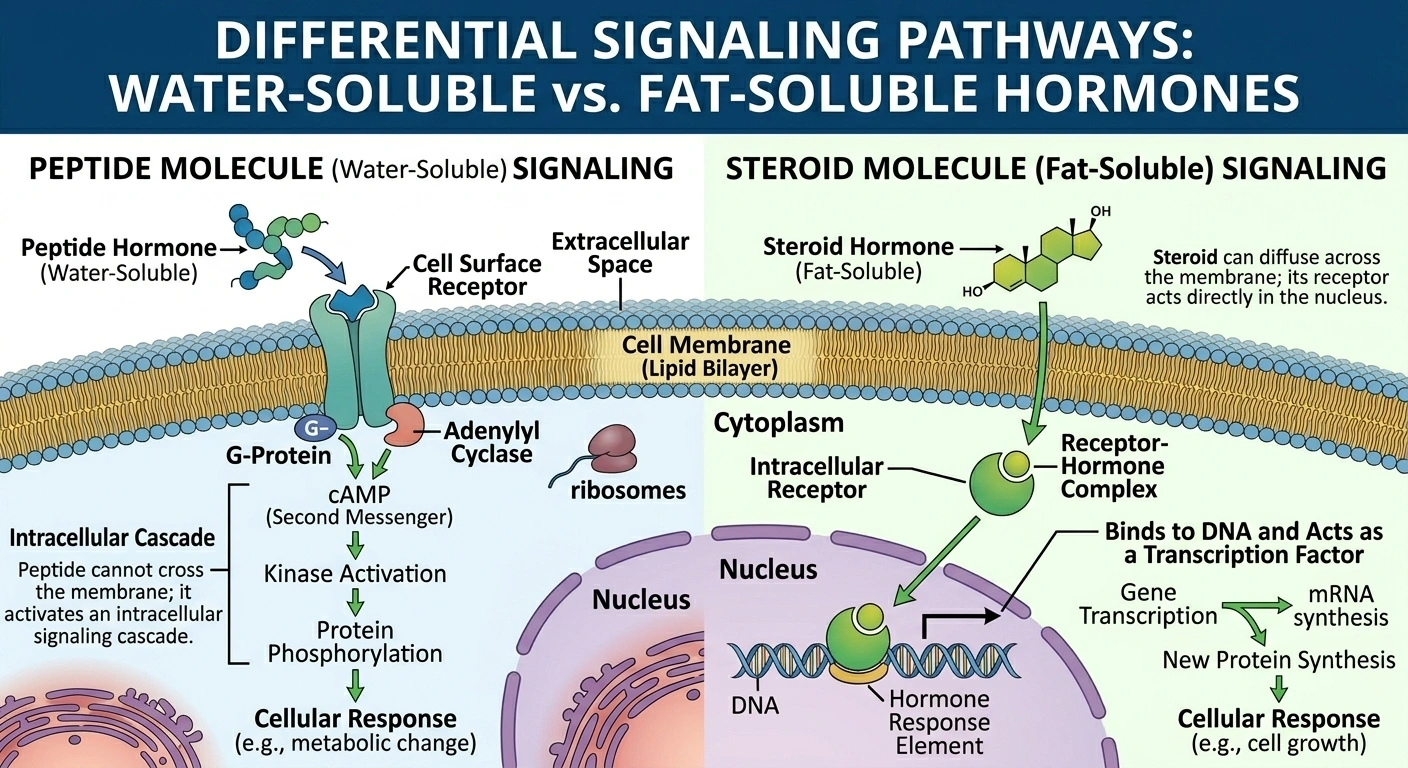
Anabolic steroids are synthetic derivatives of testosterone. They share a cholesterol-based backbone, which makes them fat-soluble. That fat-solubility is the important part: steroids can pass through cell membranes directly, without needing a surface receptor.
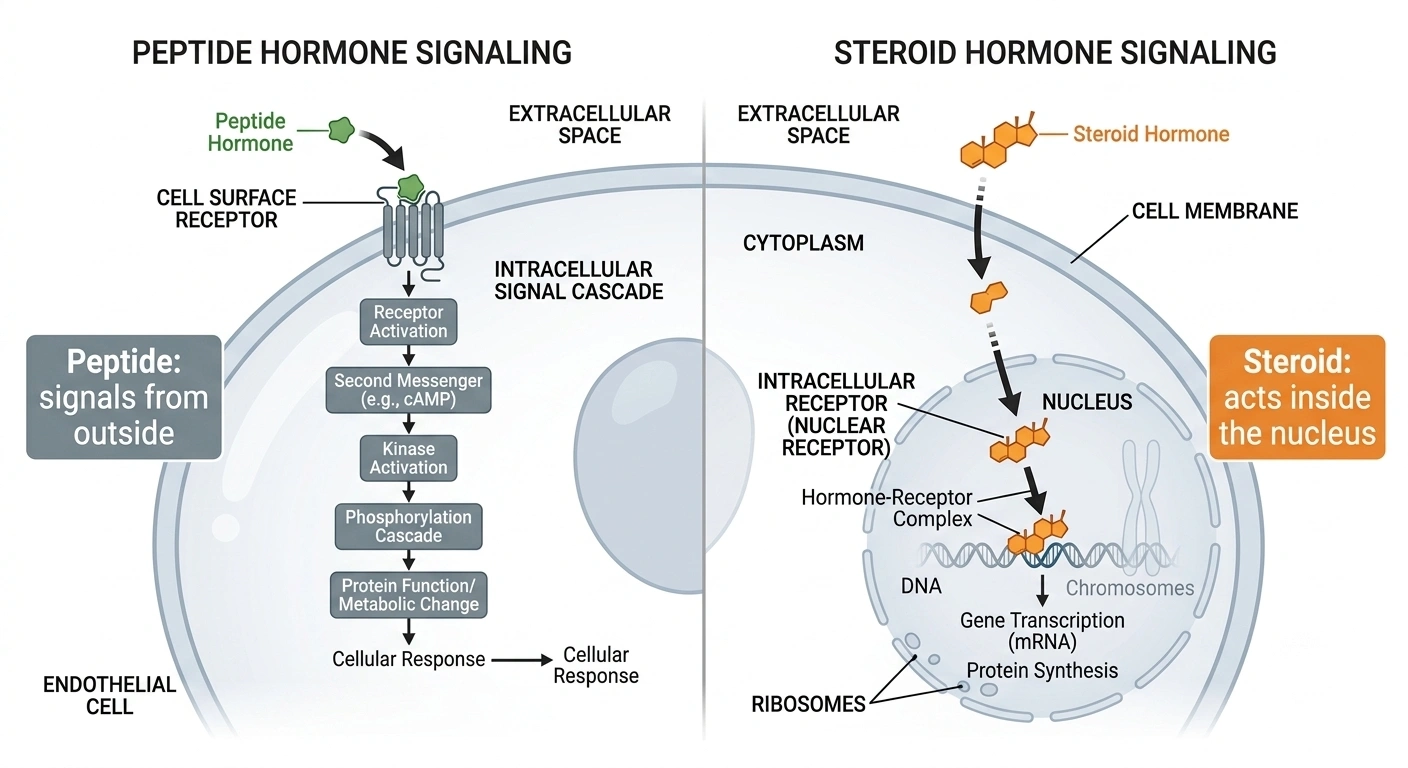
Once inside a cell, a steroid binds to androgen receptors in the cytoplasm. That receptor-steroid complex moves into the nucleus and attaches to DNA, switching on genes that increase muscle protein synthesis. The mechanism is direct. Put a steroid in, and it changes what your cells are doing at the genetic level.
That directness also explains the side effects. Flooding your system with synthetic androgens suppresses your own testosterone production, strains the liver, alters cardiovascular risk, and can destabilize mood. These aren't incidental risks. They follow from how steroids work.
What peptides are and how they work
A peptide is a short chain of amino acids. Your body makes thousands of them and uses them as signaling molecules, coordinating everything from digestion to immune response. If you want a fuller picture, what peptides actually are is a good starting point.
The structural difference from steroids is basic. Peptides are water-soluble. They don't cross cell membranes. Instead, they bind to receptors on the outside of cells and trigger a signaling cascade from there.
Performance-related peptides, the ones you'd actually hear about in a gym context, mostly work by signaling the pituitary gland to release more growth hormone. They don't contain growth hormone. They don't replace it. They ask your body to make more of its own. That's an indirect mechanism, and it's categorically different from introducing a synthetic hormone.
Why they get lumped together
Both show up in performance contexts. Both are often injectable. Both get sold by the same gray-market vendors. When the conversation is "stuff athletes use to get an edge," they blur into one category fast.
The injectable format does most of the damage to people's mental model. Anything that goes in a syringe reads as "serious drugs," and the association between needles and steroids is sticky. Add in that some peptides genuinely do improve body composition and recovery, and the conflation is understandable.
But "both can improve performance" doesn't make them the same thing, any more than caffeine and amphetamines are the same because both improve alertness.
Legal status
In the United States, anabolic steroids are Schedule III controlled substances under the Controlled Substances Act. Possession without a prescription is a federal crime.
Peptides don't have a single legal category. Some are FDA-approved drugs — insulin is a peptide, and so is semaglutide. Many research peptides are unscheduled compounds: not specifically illegal to possess in the US, but also not approved for human use. A smaller number are more tightly regulated. The legal exposure is real, but it's different in kind from steroid possession.
If you're trying to figure out where specific peptides land on safety and legality, the full breakdown covers each category properly.
Which peptides are actually banned in sport
WADA's 2026 Prohibited List bans a wide class of peptides under S2: Peptide Hormones, Growth Factors, Related Substances, and Mimetics. These are prohibited both in- and out-of-competition, and the list is longer than most people expect.
- GH-releasing peptides (GHRP-2, GHRP-6, ipamorelin, hexarelin): banned because they signal the pituitary to release growth hormone, functionally mimicking exogenous GH
- GHRH analogs (CJC-1295, sermorelin, tesamorelin): same logic — stimulating GH release is prohibited regardless of mechanism
- BPC-157 and TB-500: banned under S2 and also flagged under S0, the non-approved substances category
- IGF-1 and its analogs (including IGF-1 LR3): banned for their direct anabolic effects
If you compete in a drug-tested sport, these are not gray-area compounds. WADA and USADA test for them specifically, and the bans apply in- and out-of-competition.
Why does WADA ban peptides if they're not steroids? The anti-doping rationale isn't specifically about steroids. It's about performance advantage through hormonal manipulation. Peptides that boost GH or mimic growth factors confer an edge through an indirect mechanism, but the result is the same. The method changed; the prohibition logic didn't.
What's not banned: dietary collagen peptides, skincare peptides, and food-derived bioactive peptides. If your concern is peptides showing up in supplements, that's a much lower-risk conversation.
For a goal-by-goal look at what performance peptides can and can't actually do, see the evidence breakdown by use case.
Frequently Asked Questions
Performance-relevant peptides don't suppress testosterone the way anabolic steroids do. Steroids suppress it by overwhelming the hypothalamus-pituitary feedback loop. Your body senses high androgen levels and stops producing its own. GH-releasing peptides work on a different hormonal axis and don't trigger that shutdown.
That said, "won't shut down your testosterone" is not the same as "no hormonal effects." Some peptides interact with other hormonal pathways, and long-term data on most research peptides is thin. Assuming zero hormonal consequences because they're not steroids is not a safe assumption.
Yes, if you compete under WADA rules. GH-releasing peptides, BPC-157, TB-500, IGF-1, and related compounds are all on the 2026 Prohibited List. WADA and USADA test for these. Dietary collagen peptides and topical skincare peptides will not trigger a positive test.
If you're a recreational gym-goer with no drug-testing obligations, the practical concern shifts. But the legal category of the specific peptide still matters.
It depends on the peptide, and the research on most performance-related peptides is far less complete than it is for steroids. Some topical and FDA-approved therapeutic peptides have solid safety profiles backed by clinical trial data. Research peptides used for performance have very little human safety data.
Peptides not crossing cell membranes and not directly modifying gene expression removes certain risk categories. But "less studied" is not the same as "safer." See the full safety breakdown for specifics.
No. The category is enormous. Insulin is a peptide. The active ingredient in most anti-aging serums is a peptide. Bioactive peptides from dairy, eggs, and soy are peptides. "Peptide" describes a chemical structure, not a use case.
GH-releasing peptides and growth factors that athletes use for performance are a small subset of the broader category. Most peptides have nothing to do with performance enhancement.
Published by the PEPVi editorial team. Read our editorial standards.