
The peptide clinic industry has exploded in the last two years, and so has the marketing noise around it. If you have already decided you want peptide therapy under real medical supervision, picking the right clinic is harder than it should be.
The wrong choice means paying for a questionnaire that rubber-stamps a prescription, getting compounded medications from an unverified pharmacy, or ending up with no real physician to call when something does not feel right. The right one means actual medical oversight, quality-controlled medications, and a protocol built around your specific bloodwork.
Pricing in this article was verified as of April 2026 and is subject to change. Check each clinic's website for current rates before signing up.
Our picks at a glance
What makes a legitimate peptide clinic
Before getting into specific providers, it helps to know what separates a real clinic from a storefront that ships peptides and calls itself one.
A legitimate clinic has a licensed physician review your case before prescribing anything, not a questionnaire you fill out in three minutes. They source from FDA-registered compounding pharmacies (503A or 503B designation), which matters because the FDA found incorrect dosages or undeclared ingredients in a significant portion of tested online compounded peptide products. They require real bloodwork: labs are how a physician determines whether a peptide is appropriate for you and at what dose. And they offer ongoing oversight, not just a first shipment.
If you want a deeper checklist before signing up anywhere, our guide to choosing a peptide provider covers the full vetting process. If you are new to this space entirely, start with what is peptide therapy first.
Clinic comparison at a glance
All five providers below are telehealth platforms. The main differentiator is whether you get a live physician or an asynchronous review.
PeterMD
- Est. monthly cost
- $165–$229
- Key peptides
- BPC-157, Sermorelin, CJC-1295/Ipamorelin, GLP-1s
- Consult type
- Async
Hone Health
- Est. monthly cost
- $175–$300+
- Key peptides
- Sermorelin, PT-141, BPC-157
- Consult type
- Live video
Marek Health
- Est. monthly cost
- $225–$350+
- Key peptides
- BPC-157, Sermorelin, CJC-1295/Ipamorelin
- Consult type
- Live
Defy Medical
- Est. monthly cost
- $200–$650
- Key peptides
- 15+ peptides (broadest)
- Consult type
- Live
Hims
- Est. monthly cost
- $249–$550
- Key peptides
- Wegovy, Zepbound (GLP-1 only)
- Consult type
- Async
| Clinic | Est. monthly cost | Key peptides | Consult type | Beginner-friendly |
|---|---|---|---|---|
| PeterMD | $165–$229 | BPC-157, Sermorelin, CJC-1295/Ipamorelin, GLP-1s | Async | |
| Hone Health | $175–$300+ | Sermorelin, PT-141, BPC-157 | Live video | |
| Marek Health | $225–$350+ | BPC-157, Sermorelin, CJC-1295/Ipamorelin | Live | |
| Defy Medical | $200–$650 | 15+ peptides (broadest) | Live | |
| Hims | $249–$550 | Wegovy, Zepbound (GLP-1 only) | Async |
PeterMD
PeterMD built its reputation in testosterone replacement and expanded from there. The model is simple: order labs through Quest Diagnostics, a licensed provider reviews your results asynchronously, and if you qualify, medications ship to your door. Faster and cheaper than most competitors.
What they offer: CJC-1295/Ipamorelin, Sermorelin, BPC-157, and GHK-Cu on the peptide side, alongside TRT options and GLP-1 weight loss medications. Solid peptide breadth for the price.
Who it is best for: Men who want affordable, straightforward access to growth hormone secretagogues, or who are considering TRT and want to add peptides. Good fit if you are self-directed and do not need a lot of physician hand-holding.
Pricing: Semaglutide starts around $165/month. TRT base programs run $159–$229/month. Accepts HSA and FSA cards.
The intake process: Lab panel ordered through Quest, 5–7 business day wait for results, then asynchronous provider review. Consultation is messaging-based rather than a call.
Pros
- Lowest price point in this comparison
- Fast intake through Quest Diagnostics
- Accepts HSA and FSA cards
- BPC-157, Sermorelin, and CJC-1295/Ipamorelin all available
Cons
- Async messaging only, no live physician call
- Not available in California, Texas, and several other states
Hone Health
Hone's model is meaningfully different from PeterMD. Their intake includes 40+ biomarker lab testing, a live telehealth video consultation with a licensed physician, and a personalized treatment plan that goes beyond just medications: diet, sleep, and stress management are built into the protocol.
What they offer: Sermorelin for growth hormone support, PT-141 for sexual health, and testosterone therapy in injectable, topical, and sublingual forms. One of the few major telehealth platforms with a substantive women's hormone program (HRT for perimenopause and menopause). Ipamorelin and BPC-157 are available through their formulary as well.
Who it is best for: People who want a real physician relationship and live consultations. Especially strong for women, and for patients who want their treatment plan to account for sleep, nutrition, and stress alongside medication.
Pricing: Initial lab and consultation runs $65. Membership tiers range from $25/month (basic) to $149/month (full access with regular testing and ongoing physician support). Total all-in: typically $175–$300/month.
The intake process: Lab collection, physician review, then a live video consult. At-home finger-prick collection available. Live appointments mean you can talk through your results in real time — which sounds basic, but is genuinely unusual in this space.
Pros
- Live video consultations with a licensed physician
- One of the few platforms with a real women's hormone program
- Holistic protocol (diet, sleep, stress alongside medication)
- 40+ biomarker initial panel
Cons
- Email-only support, no phone or live chat
- Reports of missed consultation appointments
- Higher base cost than PeterMD
Marek Health
Marek Health is at the premium end of this market. Founded in 2021, they focus on comprehensive hormone and peptide optimization with a data-intensive intake. Their panels typically cover 65 to 100+ biomarkers, substantially more than the 40-marker labs common at most competitors.
What they offer: A full peptide menu including BPC-157, CJC-1295/Ipamorelin, Sermorelin, and others, alongside testosterone and thyroid optimization. BPC-157 runs approximately $350 for a 15mg vial through their compounding pharmacy partners. Expensive, but sourced transparently.
Who it is best for: Patients who want the most thorough bloodwork evaluation available and are willing to pay for it. Marek appeals to people who want to understand their physiology in depth, not just get a prescription. If budget is a real constraint, this is probably not the right first stop.
Pricing: Plans run approximately $225–$350/month for the base program, with individual peptide costs adding on. They are transparent about being a premium service.
The intake process: Comprehensive initial consultation with detailed lab review. Protocols are built around your specific biomarker data rather than a default template. Ongoing monitoring and adjustments are standard. Their Trustpilot rating is 4.8/5 based on 880+ reviews.
Pros
- 65–100+ biomarker intake panel, most thorough in this comparison
- Transparent pharmacy sourcing
- 4.8/5 Trustpilot based on 880+ verified reviews
- Ongoing monitoring and data-driven protocol adjustments
Cons
- Among the highest-priced options (base $225–$350/mo before peptide costs)
- BPC-157 approximately $350 for 15mg
- Premium positioning may exceed what most beginners need
Defy Medical
Defy Medical is the oldest clinic on this list, founded in 2013. That track record shows in how they operate: they have protocols and institutional depth that newer platforms cannot replicate yet. Their physician team includes fellowship-trained MDs, and they carry the widest peptide formulary of any provider reviewed here.
What they offer: Over 15 peptides, including BPC-157, CJC-1295/Ipamorelin, Sermorelin, TB-500, PT-141, and others depending on your protocol. No other platform in this comparison comes close on selection.
Who it is best for: Patients who want clinical depth, a long track record, and the widest possible selection of peptides under legitimate medical supervision. Strong fit for longevity-focused patients who want comprehensive multi-peptide protocols built around real lab data.
Pricing: Initial bloodwork panels run $99–$150/month at the base level with 40+ biomarkers. Total costs with medication range from $200–$650/month depending on the protocol. Some users report startup fees that push early costs above the monthly figure.
The intake process: Consultation with a licensed physician; ongoing lab monitoring is standard. More thorough than faster platforms, which means slower to initiate. Plan for a few weeks between first contact and starting a protocol. Their Trustpilot rating is 4.9/5 across roughly 4,000 reviews, the strongest satisfaction score in this comparison.
Pros
- Broadest peptide formulary in this comparison (15+ peptides)
- Founded 2013, longest track record in this comparison
- Fellowship-trained MDs
- 4.9/5 Trustpilot across ~4,000 reviews
Cons
- Requires use of affiliated compounding pharmacy, prescriptions can't be taken elsewhere
- High startup fees for some protocols
- Slower initiation process than streamlined telehealth competitors
Heads up: Hims is not a traditional peptide clinic. After settling with Novo Nordisk in March 2026 and receiving FDA warning letters, they discontinued all compounded GLP-1 products. They now sell only branded FDA-approved weight loss drugs. If you are looking for BPC-157, sermorelin, or any recovery or performance peptide, this section is not for you.
Hims
After a March 2026 settlement with Novo Nordisk and FDA warning letters for misleading marketing, Hims stopped selling compounded GLP-1 medications. They now offer only branded FDA-approved weight loss drugs: Wegovy (semaglutide) and Zepbound (tirzepatide). This puts them in a different category from every other clinic in this guide.
What they offer: Wegovy, Zepbound, and oral weight loss medication options. Intake is questionnaire-based with asynchronous provider review.
Who it is best for: People specifically seeking FDA-approved GLP-1 drugs for weight loss, particularly patients with commercial insurance who can use Novo Nordisk's savings program to bring Wegovy costs down significantly.
Pricing: A mandatory Weight Loss Membership costs $39 the first month, then $149/month ongoing, required even before any prescription is written, and it does not guarantee one. Add medication at $249–$399/month and total costs reach $400–$550/month or more.
The intake process: Questionnaire-based with asynchronous provider review. Video consultation requirements vary by state.
Pros
- FDA-approved branded medications (Wegovy, Zepbound)
- Insurance savings available via Novo Nordisk program
- Large, established telehealth platform
Cons
- No BPC-157, sermorelin, or any recovery and performance peptides
- FDA warning letters for misleading GLP-1 marketing (2025)
- Mandatory $149/mo membership fee regardless of whether you get a prescription
How to choose based on your goals
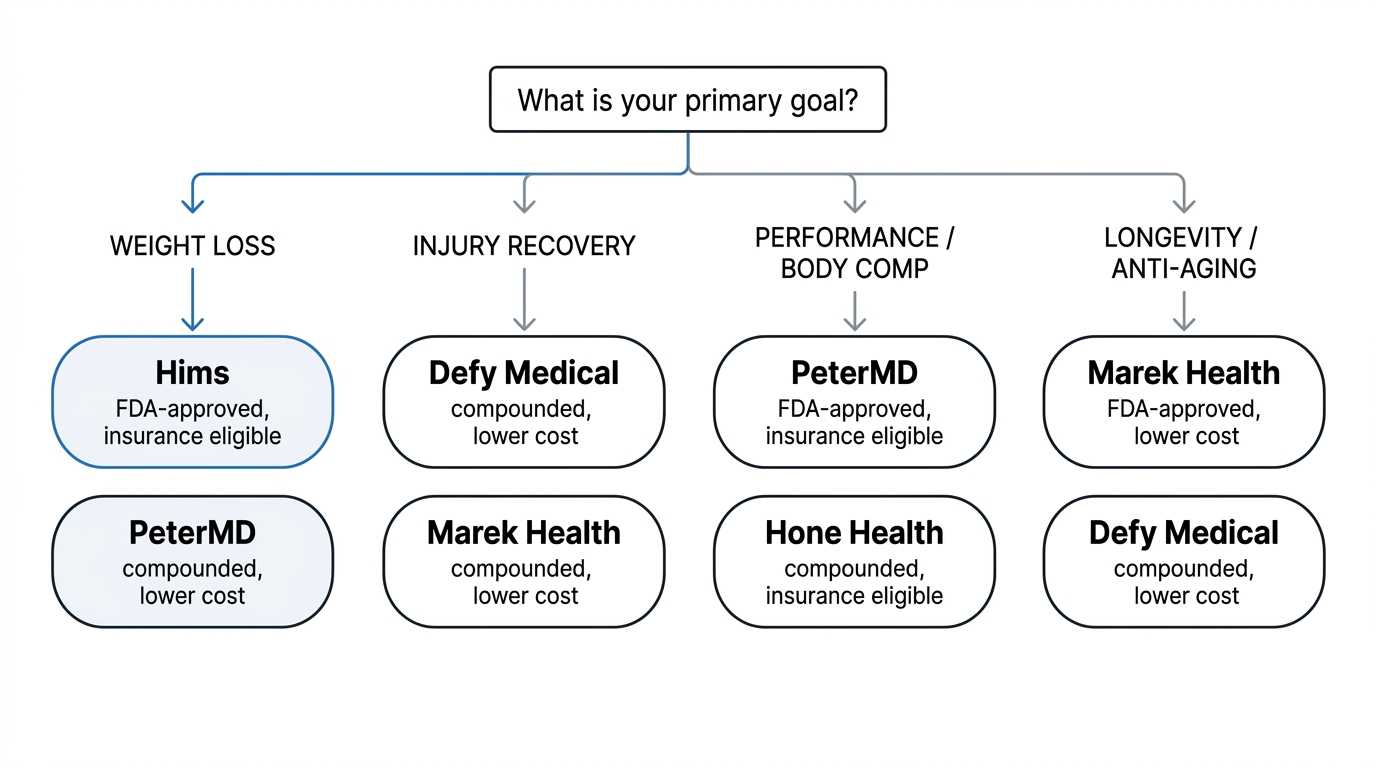
Goal-based clinic decision tree.
For weight loss: If GLP-1 medications are the goal, Hims offers FDA-approved branded options for patients with commercial insurance. PeterMD offers compounded semaglutide at lower price points for those who qualify. Before committing, read how much peptide therapy costs: membership and medication fees stack up fast.
For recovery and injury: BPC-157 is the peptide most consistently associated with tissue repair. Marek Health and Defy Medical both offer it with proper medical oversight and transparent pharmacy sourcing. Our BPC-157 profile covers what the research actually says.
For performance and body composition: Growth hormone secretagogues like ipamorelin and CJC-1295 are the main tools. PeterMD, Hone, Marek, and Defy all prescribe them. If dose optimization matters (and it does once you are a few months in), a platform with a live physician is worth the higher cost compared to async messaging.
For longevity and anti-aging: Deeper biomarker panels matter most here. Marek's 65–100+ biomarker intake and Defy's broad formulary make both strong choices. Hone's comprehensive approach to hormone optimization is a reasonable entry point if you want live physician guidance without Marek's price.
Red flags to watch for
These are the warning signs that a platform offering "peptide therapy" is not operating under real medical oversight.
No physician consultation required. If you can complete checkout without any clinical review, that is not a medical provider.
No bloodwork required. A provider who skips labs has no clinical basis for the dose they are prescribing.
Compounding pharmacy not disclosed. Any legitimate clinic can tell you which pharmacy compounds their medications. If that information is not available, that is a transparency problem. The FDA's enforcement activity in 2025–2026 found incorrect dosages in a significant share of tested products, making sourcing transparency a safety issue.
Prices that look too good. BPC-157 at $30 for a 5mg vial from an online vendor raises the question of what is actually in the vial. Room-temperature shipping of lyophilized peptides is another red flag: legitimate products require cold chain handling.
Payment by crypto or Venmo. Legitimate medical providers take credit cards. Non-traceable payment methods are how unregulated vendors avoid accountability when products are counterfeit or contaminated.
For a fuller picture on what the safety evidence shows, are peptides safe covers the research without the marketing spin.
Frequently Asked Questions
You can find unregulated peptides marketed as "research chemicals" online, but using them without medical supervision carries real risks. Quality control in that market is essentially nonexistent: FDA testing found incorrect dosages or undeclared ingredients in a significant portion of tested compounded peptide products. Beyond quality, peptides like BPC-157 and ipamorelin are not appropriate for every person. Underlying conditions, other medications, and hormone levels all affect whether a given peptide is safe and what dose makes sense. A legitimate clinic provides the clinical context that makes the difference.
Mostly no. Compounded peptides are not FDA-approved drugs, so standard insurance does not cover them. The exception is GLP-1 medications: Hims offers Wegovy and Zepbound, which are FDA-approved, and patients with commercial insurance may qualify for major cost reductions through manufacturer savings programs. Some clinics accept HSA and FSA funds for lab work and consultations even when medication costs are not covered, worth asking when you sign up.
FDA-approved peptide drugs, like semaglutide (Wegovy, Ozempic), have gone through full clinical trials demonstrating safety and efficacy for a specific condition. Compounded peptides are prepared by a licensed pharmacy for individual patients under physician supervision, but without that approval process. Less regulatory assurance around purity and consistency, which is why physician oversight and FDA-registered pharmacy sourcing matter.
Depends on which peptide and what you are treating. BPC-157 for injury recovery can show noticeable effects within two to four weeks for some patients. Growth hormone secretagogues like sermorelin or ipamorelin typically take four to eight weeks before changes in body composition and sleep quality become apparent; full effect develops over months. GLP-1 medications generally show meaningful results within four to twelve weeks at therapeutic doses. Anything promising dramatic results in days is overstating what the evidence shows.
The FDA's Pharmacy Compounding Advisory Committee is reviewing several peptides in July 2026, including BPC-157, TB-500, and Semax. Their recommendations are non-binding; formal rulemaking that follows typically takes twelve or more months. In February 2026, HHS Secretary RFK Jr. announced that approximately 14 peptides would move back to Category 1 status (legally accessible through compounding pharmacies with a physician prescription), reversing 2023 restrictions. If you are on a protocol with a legitimate provider, your physician will manage any adjustments.
Published by the PEPVi editorial team. Read our editorial standards.