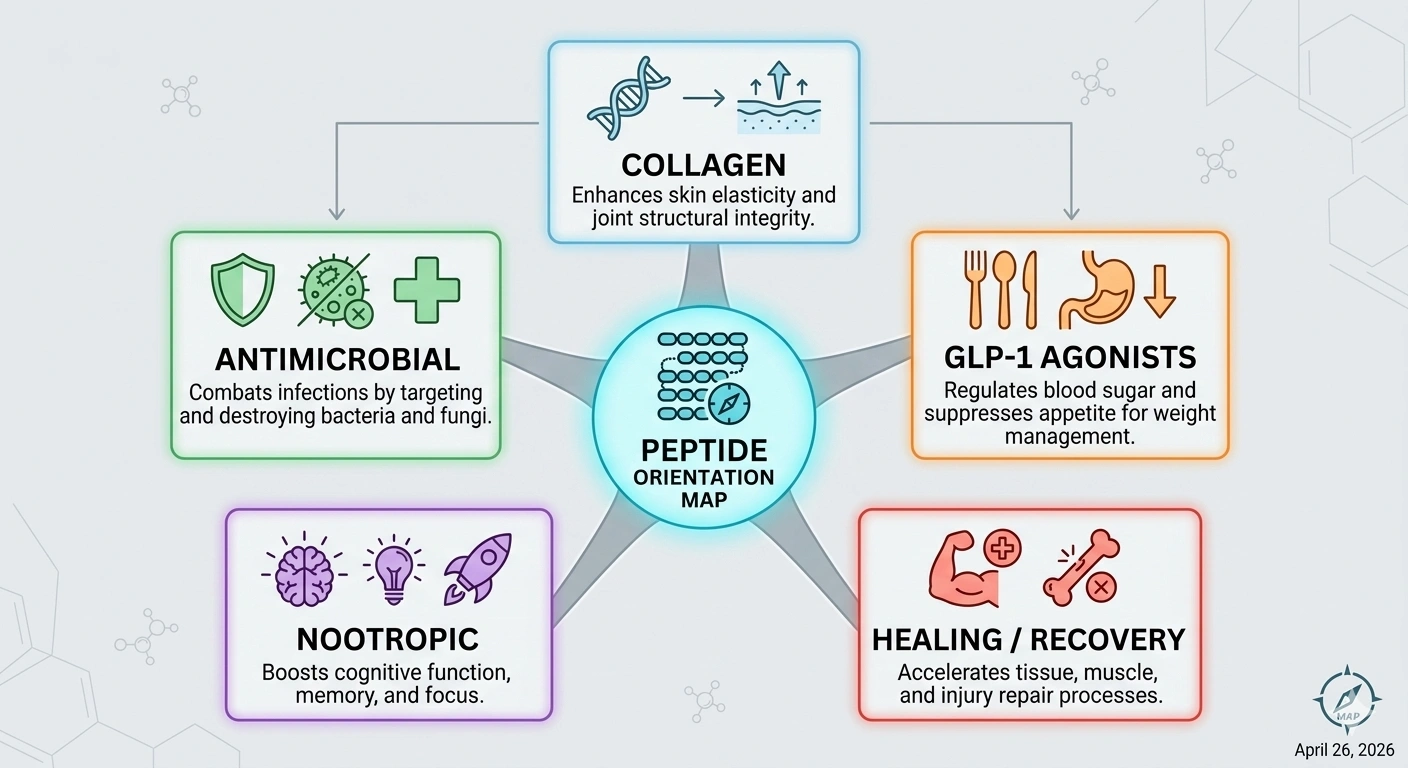
Peptides fall into five broad categories: collagen, GLP-1, healing and recovery, nootropic, and antimicrobial. They work through different mechanisms, target different systems, and sit in very different regulatory positions. Knowing which category fits your goal first saves a lot of confusion.
If you're new to this and aren't sure what a peptide is yet, start with the basics first. The short version: peptides are short chains of amino acids that act as signaling molecules. They don't just circulate passively; they dock onto specific receptors and trigger specific responses. That's why two peptides can look structurally similar and do completely different things.
Collagen Peptides
Collagen peptides are the peptide most people have already used, usually without thinking of them as "peptides" at all. They're in protein powders, joint supplements, and skincare serums.
Here's the distinction worth knowing: regular collagen is a massive protein molecule, too large to absorb through the gut wall or penetrate skin. Collagen peptides are the same material after hydrolysis, broken into much smaller fragments, typically 2,000–5,000 daltons versus whole collagen's 300,000+ daltons. Your gut can absorb those fragments within about 30 minutes.
Once absorbed, they don't directly rebuild your collagen. They signal your body to produce more. Your cells detect the fragments as evidence that collagen is breaking down and ramp up synthesis in response. It's a messaging mechanism disguised as a supplement.
Think of who's actually using this: a runner adding collagen powder to their post-run routine for joint soreness, or someone stirring it into morning coffee hoping to improve skin elasticity. Clinical evidence supports modest but real improvements in skin hydration, joint comfort, and connective tissue recovery when combined with exercise.
Collagen peptides are over-the-counter supplements. No prescription, no gray-market sourcing, no injections. That puts them in a different regulatory category than most of the peptides discussed below, and the risk profile is correspondingly low.
The collagen peptides guide goes deeper on the evidence and which forms actually work.
For what peptides do specifically in skin, there's a full breakdown of skincare peptides here.
GLP-1 Peptides
GLP-1 stands for glucagon-like peptide-1, a hormone your small intestine produces every time you eat. It triggers insulin release, slows stomach emptying, and signals your brain that you're full. The natural version breaks down in about two minutes.
GLP-1 receptor agonists are synthetic peptides engineered to do the same things but last much longer. Semaglutide (Ozempic, Wegovy) binds to the same GLP-1 receptors, produces the same satiety and insulin effects, and lasts long enough to be dosed once weekly. Tirzepatide (Mounjaro, Zepbound) targets both GLP-1 and GIP receptors, which amplifies the weight loss effect further.
This is the most clinically validated category on this list, by a wide margin. Phase 3 trials show 13–20%+ body weight reduction. An oral formulation of semaglutide launched in early 2026 and showed 13.6% mean weight loss. These are FDA-approved drugs with hard clinical data behind them, not supplements making vague claims.
The typical person here: someone prescribed semaglutide by their doctor for type 2 diabetes or obesity, or someone who's heard "Ozempic" everywhere and wants to understand what it actually is.
GLP-1 peptides are prescription medications. You can't buy them without a prescription. A compounding market exists for lower-cost versions, but quality control is uneven and the regulatory picture around compounded GLP-1s is shifting.
A full breakdown of how GLP-1 peptides work for weight loss is here.
Healing and Recovery Peptides
This is where most of the gray-market peptide interest lives, and where the regulatory situation is changing fastest.
Healing peptides work with the body's own repair processes: reducing inflammation, supporting tissue regeneration, and promoting angiogenesis, the formation of new blood vessels that supply recovering tissue. They don't force healing so much as accelerate what's already underway.
The two most discussed are BPC-157 and TB-500. BPC-157 is a synthetic sequence derived from a protein found in gastric juice. Preclinical research shows strong results for tendon, ligament, and gut healing, along with anti-inflammatory effects. The BPC-157 guide covers the evidence in detail; the short version is that animal studies are compelling and some physicians prescribe it off-label, but human clinical data is limited.
TB-500 (thymosin beta-4) works differently: rather than targeting specific tissue locally, it promotes cell migration and muscle repair more systemically. Beginners often combine them (the "Wolverine Stack") because the two operate through complementary pathways. TB-500 warrants its own read if recovery is your primary goal.
Neither is FDA-approved as a drug. Both existed in a regulatory gray zone until early 2026, when HHS Secretary RFK Jr. announced that approximately 12–14 previously restricted peptides, including BPC-157 and TB-500, would be reclassified to restore access through licensed compounding pharmacies with a prescription. The FDA's Pharmacy Compounding Advisory Committee is scheduled to review them in July 2026.
The people asking about this category are usually a former athlete whose shoulder injury isn't resolving with physical therapy, or someone post-surgery trying to shorten recovery time. The preclinical evidence is real and interesting. The human data is thin. That's not disqualifying, since many physicians prescribe these off-label, but it's worth knowing going in.
Nootropic Peptides
Nootropic peptides target the brain through neurotransmitter systems, neuroplasticity pathways (particularly BDNF, brain-derived neurotrophic factor), and neuroprotective mechanisms. The goal is better cognition, mood, focus, or stress resilience.
The most studied are Semax and Selank, both developed in Russia and used there as prescription medications for decades. Semax is derived from ACTH (a hormone the pituitary gland produces) and has been shown to increase BDNF, a protein critical for learning and memory. Selank is an anxiolytic peptide with evidence for reducing anxiety without the sedation that comes with traditional anti-anxiety drugs.
These aren't generic nootropic supplements. Where something like caffeine blocks adenosine receptors broadly, these peptides work through more specific signaling pathways that researchers are still characterizing. The mechanism is more sophisticated. The human trial data is less developed. Both things are true.
A software engineer who's run through the obvious supplements and wants something more targeted. Someone managing anxiety who wants a more specific tool than a benzodiazepine but can't find prescription options that fit. That's roughly the person interested in this category.
Most nootropic peptides aren't FDA-approved in the US. They're widely available through research chemical vendors, which creates real quality and purity concerns. The long-term risks are largely unknown, and sourcing is genuinely tricky.
Antimicrobial Peptides
Antimicrobial peptides (AMPs) are the category most people haven't heard of, and possibly the one with the most practical importance over the next decade as antibiotic resistance grows.
Your immune system already makes them. AMPs are part of the body's first-line defense against bacteria, fungi, and viruses. What makes them interesting is how they work: most bacteria can't easily develop resistance to AMPs the way they evolve around traditional antibiotics, because AMPs physically attack bacterial cell membranes rather than targeting a specific protein pathway inside the cell.
The mechanism is straightforward. Most AMPs carry a positive electrical charge. Bacterial membranes carry a negative charge. The AMP is attracted to the membrane, binds to it, and either punches holes through it or collapses its structure. Human cells have different membrane composition that AMPs don't bind to well, which is what makes them selective enough to be therapeutically useful.
The real-world picture right now: wound care applications, experimental treatments for antibiotic-resistant infections, and early pharmaceutical research. Most AMPs aren't consumer-accessible yet. Some peptides from other categories, like LL-37 (studied for wound healing), also function as AMPs. Some skincare peptides have mild antimicrobial effects as a secondary property. But this is a research frontier, not something you'd currently find in a supplement stack.
Finding Your Starting Point
A quick orientation before you go looking at specific compounds:
- Joint pain, skin health, or gut support: Collagen peptides are the low-risk entry point. Accessible, over-the-counter, and backed by decent evidence.
- Weight loss or blood sugar management: GLP-1 agonists are the only FDA-approved option with solid clinical data. That means a doctor conversation, not an online vendor.
- Injury recovery or tissue repair: BPC-157 and TB-500 are what people discuss most. They require understanding the regulatory situation and sourcing carefully.
- Cognitive performance or anxiety: Semax and Selank are the most studied options. Interesting and preliminary, with sourcing complications.
- Antimicrobial: AMPs are research-stage; not a consumer option right now.
Before trying anything in the healing, nootropic, or GLP-1 categories, the safety breakdown across peptide types is worth reading so you know what's established versus what's genuinely unknown.
Frequently Asked Questions
Whole collagen is a large protein molecule that's poorly absorbed through the gut and can't penetrate skin. Collagen peptides are the same material after hydrolysis, broken into much smaller fragments that absorb efficiently and reach the bloodstream. When you buy a "collagen supplement," you're almost always buying collagen peptides. The two terms get used interchangeably in marketing, which creates confusion, but they're structurally different forms of the same thing.
Yes. Semaglutide (Ozempic, Wegovy) is a synthetic GLP-1 peptide, a modified version of a hormone your small intestine produces naturally. The modification makes it last much longer in the body than natural GLP-1, which breaks down in about two minutes. Semaglutide is probably the most widely used therapeutic peptide in the world right now, even though it's rarely discussed in "peptide" communities, which tend to focus on recovery and performance compounds.
No, but the delivery route matters a lot. Stomach acid and digestive enzymes break down most peptides before they can reach the bloodstream, so oral bioavailability is very low for most therapeutic peptides. Collagen peptides survive ingestion because they're small and partially digestion-resistant. GLP-1 agonists have been reformulated into oral tablets (oral semaglutide became available in 2026). Most healing peptides like BPC-157 require subcutaneous injection for meaningful absorption. Nasal sprays work for some nootropic peptides like Semax and Selank.
They work through completely different mechanisms with different risk profiles. Anabolic steroids are synthetic hormones that directly force your body to build muscle tissue and can suppress your natural hormone production. Healing peptides like BPC-157 don't force any process; they signal your body's own repair pathways to become more active. They're not interchangeable, and using one doesn't mean you're using anything like the other. The "peptides are just steroids" misconception is common but wrong.
Most aren't FDA-approved for sale as drugs or dietary supplements. Peptides like Semax and Selank exist in a gray zone where they're often sold by research chemical vendors labeled "for research use only." Possession isn't illegal in most US jurisdictions, but these products aren't subject to FDA quality control, which means purity and dosing can vary significantly between sources. If you're considering them, the sourcing question matters as much as the evidence question.
Published by the PEPVi editorial team. Read our editorial standards.